
We don't often hear of hip-hop artists with advanced degrees, but that phenomenon is becoming slightly more regular. We've read a lot about hip-hop artists taking college classes, earning college degrees, and even speaking and performing at colleges. The next logical step would of course be to get a Masters degree. What hip-hop artist wouldn't be a compelling student in an M.A. in sociology, cultural studies, or even political science program? The experience artists have with culture, travel, and business likely rivals some more traditional graduate students and even the teachers in those graduate programs.
Here's a brief list of hip-hop community members who have dabbled in if not successfully completed graduate education, with a brief look at the dues they've paid:
Sicari: Sicari Ware is a Detroit artist most closely associate with D-12 (Eminem's conglomerate). He's an experienced DJ and successful-break dancer. Education: M.P.A. completed at Kentucky State University.
E-PROPS: A Haitian-American hip-hop up-and-comer born in Brooklyn. Also and independent scholar with an interest in cultural theory. Education: Masters in political science completed at Brooklyn College.
Mick Boogie: By far the most famous member of this list (that I'm aware of). Mick Boogie is the unofficial Mixtape King. He's worked with everyone from Jay-Z to Talib Kweli. Education: Masters in marketing from John Carrol University.
DJ Shy: Popular Korean-American DJ in the LA area, unfortunately better know by the masses as a sex symbol than as an important feminist voice in the male-dominated DJ industry. Education: Masters in Heath Administration from University of Southern California.
David Banner: Popular southern rapper with a strong educational background. He's also an actor. Banner testified before Congress on African America Stereotypes in the Media. Education: M.Ed. from University of Maryland (although sources are conflicting, he either is one course short or is a class and a thesis short from earning the degree).
Other updates to the list? What is graduate education's place in hip-hop? How do degrees impact street cred?
-- Nick J. Sciullo
Thursday, June 25, 2009


Sunday, June 21, 2009
Hip Hop and Fathers
We all know that urban youth have often had difficult relationships with their fathers many whom have been absent, if not abusive. There are important public policy concerns that must be dealt with regarding fatherhood and urban communities. No matter how much the issue is researched or what disciplines are utilized as ways to engage fatherhood, we'll never have an answer or a set of policies that appeases everyone. But, discussions have not been confined to academic journals. Hip-hop has made countless references to fathers--some good and some bad. Here are several hip-hop quotables that seem particularly relevant on Father's Day:
"Favorite father?
How you gonna ask me that knowin' most of my click grew up without one?"
-- Saigon, Favorite Things
"I hope you grow up to become that everything you can be
That's all I wanted for you young'n, like Father, like Son
But in the end I hope you only turn out better than me
I hope you know I love you young'n, like Father, like Son"
-- Busta Rymes, on The Game, Like Father Like Son
"You see I deal with the premise that all children are ours
And that we all travel the same path
It's just that we don't get there at the same time"
-- Pops, on Common, Pops' Rap
"I mighta ended up on the wrong side of the tracks
If Pops wouldn't've pulled me back an said yo"
-- Nas, Bridging the Gap (featuring Olu Dara)
"Now dad this is a very sensitive subject
From the first time the doctor placed you in my arms
I knew I'd meet death before I'd let you meet harm"
-- Will Smith, Just the Two of Us
-- Nick J. Sciullo
"Favorite father?
How you gonna ask me that knowin' most of my click grew up without one?"
-- Saigon, Favorite Things
"I hope you grow up to become that everything you can be
That's all I wanted for you young'n, like Father, like Son
But in the end I hope you only turn out better than me
I hope you know I love you young'n, like Father, like Son"
-- Busta Rymes, on The Game, Like Father Like Son
"You see I deal with the premise that all children are ours
And that we all travel the same path
It's just that we don't get there at the same time"
-- Pops, on Common, Pops' Rap
"I mighta ended up on the wrong side of the tracks
If Pops wouldn't've pulled me back an said yo"
-- Nas, Bridging the Gap (featuring Olu Dara)
"Now dad this is a very sensitive subject
From the first time the doctor placed you in my arms
I knew I'd meet death before I'd let you meet harm"
-- Will Smith, Just the Two of Us
-- Nick J. Sciullo
Wednesday, June 17, 2009
The Bar Exam
Artist: KRS One
Track: Classic (Better than I ever been) (featuring Nas, Rakim, and Kayne West)
Album: Released as a single.
How many y'all got criminal minded?
You? You? You? Y'all don't be blinded?
Me, I got no jewels on my neck
Why? I don't need 'em I got your respect
KRS One, for 20 years I rock
I do it for J&J and Scott LaRock
This hip hop
And we's a nation
Don't you want to hear more KRS on your radio station?
Instead of broadcasting how we smoke them trees,
On the radio we need to hear more local MC's
Where you at? Come on where you at?
This is the difference between MC'ing and rap
Rappers spit rhymes that are mostly illegal,
MC's spit rhymes to uplift they people
Peace, love, unity, and havin' fun,
these are the lyrics of KRS One
Wednesday, June 3, 2009
Hip-Hop Scholarships a Reality?
 Recently, one of the top selling R&B groups of all time, Boyz II Men, came together to talk about the initial planning of a hip-hop scholarship. They spoke at the Institute of Production and Recording in Minneapolis and discussed everything from their high school days at the High School for Creative and Performing Arts to Will Smith and Jodeci.
Like Boyz II Men or not, the vast majority of folks listened to them in the early and mid-90's. It would have been difficult not to. While the R&B group in general has become a less marketable entity than the R&B soloist today, R&B groups dominated much of the 1990s with acts like Public Announcement, Next, 112, Silk, Shai, Mint Condition all holding strong fan bases. Boyz II Men was really out in front of this phenomenon
This marks a positive development for hip-hop that often hasn't been perceived as promoting traditional methods of education. This presents an encouraging development in hip-hop's giving back to the community. Because Boyz II Men are a mainstream voice in the larger urban music movement with cross-generational and genre appeal, this could greatly enhance the reputation of hip-hop and R&B artists especially as it relates to education.
Will other artists and groups follow suit?
For the full story and to watch a video of the interview, click here.
-- Nick J. Sciullo
(Photo of Boyz II Men from http://www.famemagazine.co.uk/.)
Monday, June 1, 2009
Hip-Hop and Kids
 Not all hip-hop fans or even people influence by hip-hop were born in the hip-hop generation, a contested time period roughly between the mid-60s and the mid-80s. Today children of all ages are listening to hip-hop, the demographics of hip-hop's audience has changer, and hip-hop has become increasingly international.
Two recent stories provide interesting spring boards to a discussion of hip-hop and age. Bob Marley's eldest son, Ziggy Marley, released a kid-centric reggae album entitled Family Time. The album is a departure from his more traditional reggae products which have addressed issues as diverse as relationships, violence and parties. Not many artists are willing to depart from their bread and butter to branch out into new and unexplored territory. Common, of course, gave us the critically praised, but commercially unsuccessful highly experimental album Electric Circus. The Rugrats Movie CD did not exactly fly off the shelf, even though it features songs that included Mase, B Real, Busta Rhymes, and Loon. Ziggy Marley has a bit more ethos, being a father of five, but it's difficult to imagine a platinum-selling kids album.
What role does hip-hop have in raising children? If playing classical music into the womb is supposed to create smarter children, what affect might hip-hop have? Is Ziggy's decision to do a kid-centric project admirable?
I applaud Ziggy's choice and have always been a fan of his music. I hope that he'll inspire other artists to address children in their music. Hip-hop and reggae can and often have positively affected the lives of many. Hip-hop is a pedagogical tool. Why not begin to teach children through hip-hop, not just about it?
Also in the news, Akon recently spoke to a small gathering of teenagers in Poughkeepsie, New York. Akon's no stranger to trouble, and in this talk he helped educate teens about making the right decisions and the dangers of gun violence. The appearance was not part of the community service he was ordered to complete as a result of his KFest fan-launching incident in 2007. Unfortunately, we do not see enough hip-hop artists talking to youth. It happens here and there, but relatively few young people can claim to have listened to hip-hop artists other than on a CD.
As a powerful social movement, hip-hop must take a more forward-looking stance on its relationship with children of all ages.
(Photo by Ann Johansson/LA Times)
Tuesday, May 26, 2009
The Bar Exam

Artist: Black Rob
Track: Life Story
Album: Life Story
Never had a dime, my life a crime
Had me when I was nine, mom drunk off of wine
Ran with all kinds, her mind stayed wit the stupor
'til a point she paid no mind to the Super
Stay mad but stay frontin' with smiles
Stayed on the ground once and a while
First day of school never had nuttin' to style
Mister Colondre stressin' I ain't come in a while
It was a bummer, rocking the shit I rocked all summer
On the first day I was feeling some kind of way
and she wasn't trying to do nuttin'
You would think for the sake of the kids
she would enroll in school or somethin'
Now I know then was even harder
Especially for a single mother raising me with no father
Shit living up in this tenement, eating stale M&M's
Talking wild shit to Spanish immigrants
I speak in codes,
man "tu sabe"
Always "calle te" then “bendición” to mi madre
Even though she did nuttin' for me
Track: Life Story
Album: Life Story
Never had a dime, my life a crime
Had me when I was nine, mom drunk off of wine
Ran with all kinds, her mind stayed wit the stupor
'til a point she paid no mind to the Super
Stay mad but stay frontin' with smiles
Stayed on the ground once and a while
First day of school never had nuttin' to style
Mister Colondre stressin' I ain't come in a while
It was a bummer, rocking the shit I rocked all summer
On the first day I was feeling some kind of way
and she wasn't trying to do nuttin'
You would think for the sake of the kids
she would enroll in school or somethin'
Now I know then was even harder
Especially for a single mother raising me with no father
Shit living up in this tenement, eating stale M&M's
Talking wild shit to Spanish immigrants
I speak in codes,
man "tu sabe"
Always "calle te" then “bendición” to mi madre
Even though she did nuttin' for me
Acknowledge me as I run down my life story
Monday, May 25, 2009
Michael Vick is Out; T.I. is In ... Fair Justice or PR Maneuvering in the Courts?
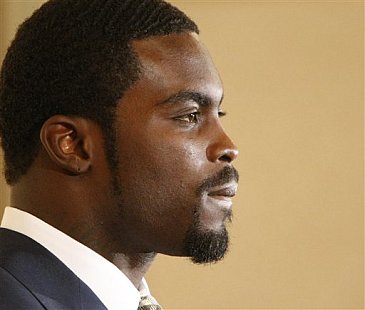
Last week Michael Vick was released from a
Much like he has during this whole ordeal, Vick remained quiet following his release and avoided the media altogether upon leaving the prison facility. There were no cries at how he’s a changed man and no words on his future rehabilitation efforts. He simply got into his fiancé’s car and went home.
Meanwhile, the media frenzy that has surrounded Vick from day one picked up coverage like the well oiled machine that it is. ESPN was out in full force airing coverage live from the scene of his release and the home he would return to. Pundits were back again, declaring that Vick had much more to do if he wanted to return to his former job, including begging NFL Commissioner Roger Goodell for another chance. PETA has not stopped their campaign against Vick either, requesting that he undergo a brain scan to prove that he doesn’t have an anti-social personality disorder before returning to the NFL.
Fast forward to this week, another
Unlike Vick, T.I. has taken a completely different route regarding his pending incarceration. While Vick did his best to avoid the media, T.I. has turned it into a large PR campaign by continually speaking out to the media and even capitalizing on the situation with the MTV show T.I.’s Road to Redemption.
The PR campaign exercised by the T.I. camp has paid off. While Vick spent 19 months in prison for an arguably lesser offense, (Vick’s actions were offensive but he dealt with dogs, T.I. dealt with machine guns) T.I. will only be spending a year away from home. Vick has also taken a much larger financial hit as he had to walk away from his $130 million contract. Let’s not forget that fellow emcee Foxy Brown was also sentenced to a year in prison for violating her probation … for fighting her manicurists in a nail salon.
The role the media has played on these two individuals cannot be denied. Vick entered prison a man convicted well beyond the courts with a damaged reputation that will likely be impossible to repair. On the other hand, T.I. has successfully convinced the media that he is a changed man before spending one day behind bars.
The obvious question to ask now is whether justice has really been served. Is the role of the media too strong? If you’re an entertainer, has T.I. set the precedent on dodging a severe sentence by working the airwaves in a positive way?
One thing is for sure, however, when T.I. walks back into society a free man in one year … the media will be waiting for him … as he steps to the podium.
Monday, May 18, 2009
The Performance Rights Act: A Big Win for Artists or A Record Label Bailout?
Last Wednesday the House Judiciary Committee passed the Performance Rights Act (H.R. 848), which would require radio stations to pay royalties to artists for playing their music, similar to how other platforms like satellite, cable, and Internet radio stations already do. Under current law, musicians receive zero income when their music is played on AM / FM radio.
"The time is finally ripe for establishing some form of equity for recording artists, allowing them to be paid fair compensation for their creativity." - Rep. John Conyers
While the premise of this legislation is a rather logical one - artists should be paid for their creativity and their work - questions still remain and opposition will certainly follow. Modifications have already been made to the bill to minimize the impact it will have on small broadcasters. As of right now, stations with an annual gross revenue of less than $100,000 would pay $500 each year. Those with revenues between $100,000 and $500,000 would pay $2,500. Finally, those fortunate enough to have revenues between $500,000 and $1.25 million would pay a fee of $5,000 per year. Conyers has also requested the Government Accountability Office to conduct a study of the bill's potential overall impact on radio stations.
While the full impact of this bill is yet to be seen, it may have already served the purpose of opening the eyes of many people that a glaring problem exists in our current radio format ... artists are not being paid ... at all. The relationship between artists and radio stations may have been a mutually beneficial one in the past when radio stations could profit off of the airplay and artists could profit off of the exposure through record sales, however, that is the old formula. Now, the evolving music industry must look at every possible avenue to find profitability, even if that means confronting your once closest friend.
Thursday, May 14, 2009
When Rappers Had Day Jobs: The Rick Ross Credibility Conundrum
 Rick Ross was a C.O. (at least, so says 50). So what? Why does it matter? Does the argument over Ross’ street cred have any relevance to the larger hip-hop nation? After all, hip-hop artists evolve from real people with real world concerns, like eating and keeping a roof over their heads. Real world concerns lead to real world jobs, like delivering packages, working construction, and, yes, getting on as a C.O. Not every rapper actually hustled on a corner in order to feed his daughter.
 Hip-hop artists also evolve after hip-hop, right? AmeriKKKa’s Most Wanted now makes family-friendly comedies. The Cop Killer is a cop now (or at least he plays one on TV). Flava Flav does whatever it is that he does. Uncle L is about to star in an “NCIS” spinoff. That’s a long way from Farmer’s Boulevard. And the stage personas of many rappers are characters any way, right? How many self-proclaimed macks are actually family men, especially in middle age? How many so-called gangsters have never seen Central Booking, or done a bid? So, why the uproar over Ross?
The answer is that, even as its messages became less "positive," even as it went through a period of cartoonish gangsterism and materialistic excess, hip-hop was consistent in one way. There was always an undercurrent of counterculturalism, and a critique of the criminal justice system. The critique was not always as well articulated as in "Illegal Search" or "Black Cop," but it was there. Biggin' up your man upstate, celebrating the dealers and the hustlers, and rapping about one's battles with the DEA or ATF all comment, to an extent, on limited choices, neglect of urban communities by the state, and violence perpetrated against those communities by the state. If the state is an antagonistic "other" in hip-hop culture, then the representative of the state, especially a representative of the "system," can’t be legitimately hip-hop. At least, so goes the theory.
Maybe it’s time to discard that theory. Just as it took hip-hop artists getting involved in the business side of the music in order for them to really get paid, maybe hip-hop heads need to be open to infiltrating The Beast so that change can occur there as well. Although he had his problems, the declaration of Kwame Kilpatrick as the "Hip-Hop Mayor" was an important statement about where hip-hop can go in terms of bringing about social change. Maybe we need more hip-hop mayors, hip-hop judges, hip-hop cops, and, yes, hip-hop COs.
- Horace Anderson
Tuesday, May 12, 2009
Forgeries: Canal Street to the Port of Miami
 It looks like Rick Ross cannot keep himself out of the news. After the much over-hyped confrontation between Ross and 50 Cent, Ross now finds himself at the center of a "street cred" scandal. On the May 2009 Edition of XXL, Ross sports Louis Vuitton shades, prominently displaying the distinct LV logo.
It's no surprise that hip-hop artists are wearing fake glasses and sneakers. The money's seldom as good as the talk on the latest single, but what new questions are raised when an artist publicly flaunts forgeries? Is there a difference between wearing fake shades on the airplane or at an award show and wearing them for the cover of a magazine?
The LV folks didn't take lightly to Ross's stylistic decision. A lawyer for Louis Vuitton, Michael D. Pantalony, wrote XXL this letter:
Dear Editor:
We were dismayed to see the cover of the May 2009 issue of XXL Magazine, which features a photo of Rick Ross wearing a pair of sunglasses prominently featuring counterfeit Louis Vuitton trademarks. Because the photo has generated considerable confusion among your readers and Louis Vuitton customers among others, we feel it is important to clarify several points.
The first is that the sunglasses Mr. Ross is wearing were not made by Louis Vuitton, and in fact, are counterfeit. Louis Vuitton did not grant permission to Mr. Ross or to whoever did make the sunglasses to use our trademarks. The second is that no affiliation, sponsorship or association exists between Rick Ross or XXL and Louis Vuitton. The third is that counterfeiting is illegal.
Thank you for giving us the opportunity to correct the confusion.
Sincerely,
Michael D. Pantalony, Esq.
Louis Vuitton Malletier
Louis Vuitton Malletier
 Copyright infringement with respect to handbags, sneakers, and clothing has long been a problem and although sporadic reports of crackdowns have surfaced, it seems the forgery market is alive and well. Canal Street, long the center of the forgery market, is but the beginning of the problem. In almost every major U.S. city you'll find places to purchase knockoffs so good they might even be better made than the originals. I recently spent time in South Florida, where the world's "largest swap shop" happens to be located. The vendors were stocked with counterfeit merchandise. Some of it looked good, some of it... well... didn't exactly make the cut.
 The problem is prevalent and law enforcement seldom has the resources to track down ever corner store, tent, and flea market booth to find those profiting from breaking intellectual property laws. With serious crimes like murder and assault often large problems in metro areas, it's logical to see why IP violations fall by the wayside. Many would logically argue that fake Kate Spade bags don't cause double digit increases in a city's murder rate.
The problem does not stop at hip-hop. Suburban families purchase counterfeit goods, students (even law students) flaunt their illegal merchandise in classrooms and lectures. The irony of a law student sitting in intellectual property law, laptop encased in a fake Vera Bradley computer bag, a fake Dooney & Burke purse tucked neatly under a chair crammed full of Nutshell books, and fake Juicy Couture sweatpants on is not a foreign image. It occurs in colleges across the country on a regular basis. There comes a point where consumers will actually flaunt how accurate their forgery is as opposed to saving money to buy the genuine article. I've observed some of those conversations and I'm sure I'm not the only one.
How do we combat this sort of IP violation?
The Bar Exam

Artist: Common
Track: Real People
Album: Be
I wonder is the spirits of Bob Marley and Haile Selassie
Watch me as the cops be tryin' to pop and lock me
They cocky, plus thier mentality is Nazi
The way they treat Blacks I wanna snap like paparazzi
We're the children of a better God searchin' for better jobs
We could cop ghetto cars tryin' not to catch a charge
They say the dope game is sour
Now they doin' homework that's when they follow you for hours
Come to your crib and devour all that you work for
Must be more than paper these niggaz hurt for
Through the purple haze I circle days I rhyme for work that pays
Tryin' to reverse the slave's mind and insert the brave mentality
Heard that it's drama at home
Can a dude break free and still get honored at home?
I was told by a chief it's the games nature
When you're glowin' some will love and some will hate ya
It's real people
Saturday, May 9, 2009
"The Carter"

Lil’
Lil Wayne’s lawsuit arises from presentation of “The Carter” at this year’s Sundance Film Festival in January 2009, with plans for nationwide theatrical release of the documentary to follow this year. The documentary was shot over several months in 2008 and brings the audience into the controversial rappers life through concert and studio footage, interviews and behind-the-scenes access originally granted by Lil Wayne.
The complaint states that in 2007, Lil
Prior to its debut at the Sundance Film Festival, in December 2008 and early January 2009, copies of the nearly complete documentary were submitted to Lil Wayne’s manager, who rejected portions of the footage, asking that certain questionable content, which management felt painted Lil Wayne in a negative light, be removed from the film. Lil
Despite this request, the film debuted at the 2009 Sundance Festival with the questionable scenes intact. The Carter screened January 17, 19, 21 and 23, despite requests submitted by Lil
On Wednesday April 22, 2009, Los Angeles Superior Court Judge Michael Mink refused to grant an injunction blocking the upcoming release of The Carter. Quincy Jones stated in Variety Magazine that “We’re very pleased with the court’s decision. . . . We made a great film, which was incredibly well received at Sundance, and showcases Lil Wayne's extraordinary talent.” The Carter, which was directed by Adam Bhala Lough, has no scheduled theatrical release date as of this time.
Wednesday, May 6, 2009
Report Suggests Illegal Downloaders Are Also Most Likely to Purchase Music
 Research findings in a recent report issued by the BI Norwegian School of Management seem to support the long and widely held belief among P2P file sharers that this group is ten times (that’s right, ten times!) more likely than their non file sharing counterparts to purchase legitimate downloads from services like iTunes.
 This finding supports a 2006 report issued by the Canadian Record Industry Association that P2P users do in fact purchase music and are not the primary cause of recently sluggish sales. In fact, all of the research is pointing toward consumer disinterest or dissatisfaction, not illegal downloading, as primary factors.
BI’s Auden Molde was reported by Norwegian’s Music Information Centre to say: “The most surprising finding of this study is that the percentage of legally downloaded music is so high. The results of the study suggest that legal downloads outnumber illegal downloads by a wide margin. We also saw that users stating that they were involved in illegal P2P file sharing were in fact the legal download services' biggest clients.”
So perhaps the P2P file sharing "try before you buy" model is more boom than bust for a music industry that only puts 2 or 3 purchase-worthy tracks on a CD these days. Maybe ... just maybe, the P2P model is picking up the slack and filling in the information gap for consumers because radio stations fall far short by choosing to play (for some strange reason) the same 7 (or is it now 6?) songs every hour on the hour. Case in point: if I hear “Poker Face” one more time, I swear...
- Tonya M. Evans, Assistant Professor of Law and author of Copyright Companion for Writers
Visit her blog @ ipprof.blogspot.com
Monday, May 4, 2009
Are we confusing the already confused?
 Dr. Marc Lamont Hill, the hottest new race public intellectual, recently described an intellectual this way: "As an intellectual, it's my job to take ideas that pass as common sense and complicate them." You can read the full story in the Philadelphia Daily News. Although Dr. Hill is clearly joking, there's an important grain of truth to what he says. The way individuals describe problems and make arguments affects the ability of others to empathize, sympathize, and act on those very issues.
Does hip hop and its intellectual investigation risk obscuring the simple truths of life? We know there is racism and sexism. We know that public policy has not always treated the economically deprived fairly. We know illicit drug use is a problem and so on and so forth.
Intellectuals and hip hop artists are alike in many respects and one of them is the confusing language we often use to describe situations and problems that we really wish people outside of our community or intellectual persuasion understood.
Let's look at some examples. When Chamillionaire released "Ridin'," quite a few colleagues had no idea what he was talking about. Even folks who listen to hip hop are sometimes left confused by hip hop lyrics. When Jagged Edge released "Cut Somethin'," who outside of the South new what they were talking about? With hip hop vernacular continually updating and regionalizing itself, its no wonder confusion abounds. The problem is, logically, that it is often difficult to understand what a song critiques or asks of the listener.
Intellectuals have the same difficulty. If one is not accustomed to reading post-structuralist theory, then the material seems quite dense. Likewise an analytical lawyering class might be difficult to grasp for non-economics majors. Reading some of today's Neo-Marxists can be more frustrating than reading William Faulkner backwards. What power can intellectuals have if they cannot articulate their arguments? Part and parcel or persuasion is clarity. Without clarity the message is muddled and the results are often uninspiring.
Language constructs reality, but also, unfortunately, can be used to build a fence around an individual's reality that obscures appreciation from outsiders. This does not mean we should do away with the useful tools of irony, hyperbole, and the like, but that we must be willing to take the extra step of explaining our work, be it album or law review article, to more than our colleagues and compatriots.
That seems to me to be the very point of being a public intellectual.
(Photo courtesy of Wayne Riley)
Sunday, May 3, 2009
The Bar Exam

Artist: Jadakiss
Track: What If (feat. Nas)
Album: The Last Kiss
Take a second, what if we could rewind the hood?
Better yet, what if the L.O.X. woulda signed with Suge?
What if Puffy never signed us?
What if Oprah made them comments
Like Imus?
What if you designed this
Thought like I did?
Said it like this:
What if Peyton was fighting dogs instead of Mike Vick?
What if Arnold would just let Tookie get life?
What if B.I.G. missed the party,
What if 'Pac missed the fight?
What if you was caged in?
What would you change then?
What if there was no Rocafella law for "Made Men?"
What if hate ran through me?
And what if Portland
Would've drafted Jordan
Instead of Sam Bowie?
What if you really have to be nice to get a deal?
What if all of these rappers' ice was really real?
What if I hit you with the razor from cheek to chin?
What if Mike Jackson never would have bleached his skin?
Subscribe to:
Posts (Atom)


